As An Amazon Associate I Earn From Qualifying Purchases At No Extra Cost To You Learn more.
We are used to seeing suet cakes in the winter advertised to help the birds in cold weather. Cold and wet weather means that non-migrating birds need more calories in their diets. The fat in a suet cake fills that need perfectly well. Although I love to see a red cardinal in the winter, my favorite non-migrating birds are my lovely hens scratching around in the yard.
Even if you give your hens the most beautiful and elaborate shelter, they will choose to get out in all sorts of weather. Chickens are incredibly cold hardy despite their small size and will commonly walk out into the snow to satisfy their curiosity and love of the fresh air. As long as their shelter is available to them as a free choice they will decide when they need to warm up and when they want to play in the yard.
There are lots of cute ideas on the web about how to make Suet Cakes that use bird seed, raisins, nuts and such, but I get really excited about ways to feed my chickens using kitchen scraps. [Yes, I know I need help.] For me, a Suet Cake for my chickens takes it up a notch because I am able to use the extra cooking grease that is so hard to dispose of anyway.
My husband covets bacon grease (I’m not really a fan), but beef and chicken drippings are really just a hazard to dispose of. Anyone teaching a kid to cook has probably had the fun of trying to calmly explain to the child why you told them 30 minutes ago not to pour cooking fat down the drain as you try desperately to heat up the sink and pipes before the fat creates an impenetrable clog.
Making your own Suet Cake is not only a win for your sink, a win for making use of kitchen waste, and a win for your hen’s winter diet: but I also found a grain and seed substitute that makes use of that ‘dust’ that your hens won’t eat in the feeder…quadruple win!
If your hens are like mine, they will gobble up the pellets and refuse to eat all the little crumbs in the tray. If you hang your feeder high enough they won’t be able to scratch it out on the ground, but they will still use their beaks to display their disdain for it. I need to find an easier way to do this, but this time I sifted that out and collected it. I just keep a jar under the sink with this ‘pellet dust’ and I can mix up a ton of suet cakes at once when their are left-over drippings. I’m guessing it is full of minerals the girls should be eating anyway.
Keep adding dust past the ‘brownie mix’ stage and go all the way to ‘wet sand’ stage. Press it down into your container, put the lid on and pop it into your fridge or freezer. It will harden up fairly quickly. Make them into whatever shape you can easily pop out. They don’t make my little round Ziplock containers anymore, but these Glad rectangular ones are also 8oz just like the containers I use for the whole process.
I bought this large suet cake holder that I not only use for winter snacks, but also for holding produce up off the ground to entertain the hens. It’s my favorite way to get rid of a zucchini I forgot about in the fridge. As I have been making these, I try to make them bigger and bigger because it’s a more efficient use of my time and space….and at some point I may buy a flock block if I find I fall behind in having enough snacks.
Here you can see the chickens pulling out cucumbers and then carrying them off to their own corners. They love things like cucumbers and squash! There are lots of great suet cake holders out there, but the one I have here is heavy-duty. If you want one like mine, look for an easy to fill one because the hens act like little toddlers waiting for candy. I’ve had a hen more than once jump up waist high and try to nab a treat. It’s all one compartment so you can pop really big things in. We’ve put about 10 corncobs in there after supper and watched the chickens for an hour. It’s just nicer to have it up off the ground so it doesn’t become an eyesore. They also aren’t eating dirt and other ‘stuff’ accidentally. (I’m sure they eat enough of that on purpose!) Because it swings from a chain all over the place it seems to entertain them more too, and that’s even more fun to watch.
As An Amazon Associate I Earn From Qualifying Purchases At No Extra Cost To You Learn more.
Welcome to my backyard chicken coop. It is a daily joy for me to be able to see this pretty little doll-house of a chicken coop in the backyard. Even when the chickens are away at their ‘summer home’ the coop is a delight.
I’ve waited so long to get chickens, I want to squeeze every bit of joy out of this experience that I can. A handsome coop has made my kids and husband enjoy it more. Each of the kids (even as teenagers) have taken their friends to visit the chicken coop. My husband stares out at them several times a day while sipping his coffee. I’ve seen impressive shed-sized chicken coops and heart-stopping stone chicken coops, but when it was time to actually put down the money and accept that when I sell this house not everyone wants to try to keep a flock of hens inside a subdivision, I knew I had to be realistic. I couldn’t believe my luck when I ran across this coop on-line. It is a miniaturized version of one I saw years ago and fell in love with.
I ordered it immediately because COVID had created so many shipping delays I didn’t want to take any chances. When it arrived I realized the cute paint job wouldn’t hold up to the weather very well. So I painted all the pieces while they were still flat. It was a good opportunity to use up the extra paints I had…half a quart of white glossy exterior here, full can of a different brand flat white there, plus 3 cans of 8 year old spray paint at the very end.
When I assembled it I was so in love! But then I realized that it felt a lot smaller than I imagined and created some problems. At that time I was in sold on the Joel Salatin chicken tractor idea, and convinced I was going to pull this coop to a different spot every day so the chickens could have fresh grass! Yep, I live in a dream world! Even in my state of denial I could tell this coop could not sustain dragging across a lawn.
In addition, there was a “feed storage space” built in which created a wooden floor right on the ground. If you’ve ever lifted even a random board that’s been on the ground over a year you know that mice and snakes consider that prime real estate. If you store any food there you just put in a buffet!
Then there was the ramp that was supposed to go up to a floor area. Double why? Chicken ramps get covered with poo and look nasty and baby chicks can’t use them. And why put a floor in anywhere? Do you enjoy cleaning out chicken poo? One of the best innovations of chicken keeping has been returning to the old-fashioned deep litter method that lets you clean out the chicken coop only once a year. Some do it even less than that.
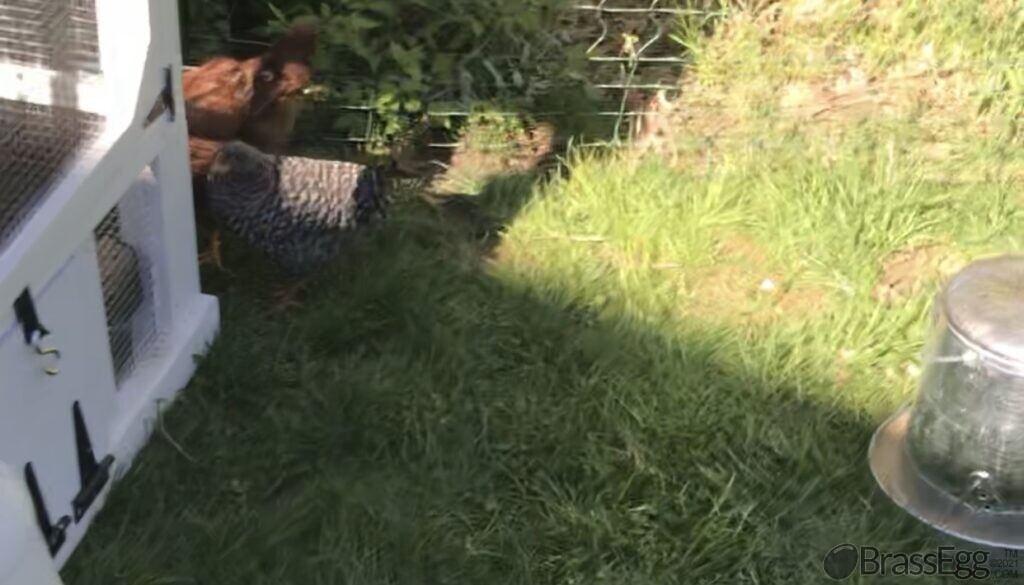
Lastly, there just wasn’t enough space. We moved the babies into it for a week before taking the coop outside, and it was clear we would need a chicken run/yard. The description was honest, it would only hold 2-3 chickens, but 9 of my baby chicks had survived. I also didn’t have bantams, I had bought Road Island Reds and Barred Plymouth Rocks, some of the bigger chickens on the market. My solution wasn’t simple, but it addressed all four problems.
Adding another “story” of living space would mean I could put skids on the ground contact points to make it easier to drag from location to location (please!) Large eye-bolts were attached to the heavier lumber used as skids to make attaching a rope easier. The “feed storage space” would become more scratching area, making the space under the nesting boxes usable. Baby chicks or injured hens could walk from front to back without needing a ramp. An extra “floor” would create more space by making more roosting areas. On top of that, the deep litter method is easier if you don’t have support boards running along the ground that either rot in the nutrient-dense litter or that provide a safe home for a mouse or snake.
Because I have never done this before, I hoisted the entire finished coop in the air to try to gauge how much height I should add. There are certainly easier ways to do this, but I wanted tosee if it would be too top heavy, be too tall, and if it would provide enough space inside. Turned out that 12′ was the right height to add, which would have been a decent guess and have saved me 4 days of balancing the coop on buckets and blocks.
I used the stack of extra 2″x3″ studs I had in the garage and was able to cover the exterior walls with the useless floor that came with the coop. More 1″x1″ hardware cloth added to the bottom of the ‘attrium’ also made it possible for me to create a little pop door for the chickens that can be left open all the time instead of opening the large door needed for feeding.
I honestly thought this would solve my problems with the design of the bought coop, but my learning curve has been steep even from there. The chicken tractor idea was the first to go. I moved this monster three times and realized that was not sustainable. The idea of a chicken tractor makes a ton of sense, but not for a suburban lawn. It’s not just the weight of my pretty coop and the fact that most chicken tractors are more of a summer time shelter thing. There is also the fact that the idea helps equally distribute fertilizer across the green space. In open fields where you aren’t surprised to step in an animal poo, ok. In your backyard if you don’t want your children’s friends to wear their nice shoes in the backyard that becomes an issue. We quickly found the ideal backyard location for ‘chicken watching’ and planted the coop there. I’ve adopted the deep litter method, which is my preferred option, and still working through a concept I have for composting directly in the chicken run.
The nesting box was another problem area because the original design had used a poo-catching floor which allowed hens to walk right into the nesting boxes without flying up or even a little hop up. Adding roosting bars over deep litter made weekly cleaning a moot point. However, chickens want to lay their eggs at the same level or below where they roost. So, I removed the floor of the nesting box and now the hens lay their eggs one level down where the ‘feed storage area’ used to be. This is still not good enough for some hens and they insist on laying on the ground level…but we are making progress on that.
The little pop door was so cute and clever, but this is the only blurry photo I got of it while it was new and clean. It was designed with hinges on the bottom due to advice that you never want your coop door to be able to shut the hens out accidentally. The pop door helps a little bit in protecting from predators because the door is too small for large predators to fit through, but it also gives the chickens constant freedom instead of waiting on a human to let them out in the morning or closing them up at night.
However, the door created a bit of a ramp that the chickens constantly slipped on, and quickly became covered in mud and poo which is an eyesore. In addition, an industrious mouse had found this shelter and was building it out as a condo near the feed source. Taking the cute door off was necessary.
The most important issue is something I will be tweaking all winter…. ventilation. Adequate ventilation is essential to chickens. It is more important than heating the coop beyond providing wind breaks. That is why the summer coop is so open and airy. This coop did not have adequate ventilation when I first constructed it, and I am still trying to figure out if I should add more going into winter. At the same time, I’m worried about the cold winter winds and I’ve installed a large sheet of plexiglass on the house side of the coop to protect the atrium from rain and snow and harsh winds. The feed no longer gets soaked and I see the hens enjoying the view during downpours. I have flimsy plastic to add inside the other screens of the atrium, but I don’t want to ruin all the ventilation. I’ve read they need the ventilation to be above their roosts, but I don’t know what that means for my ground-level doors.
In the end, it would have been cheaper and easier to have constructed the coop myself. I knew that going in. It would have never looked this good though. I am pretty handy and have built a few things in my time, but I know my limits. Constructing all the little doors and getting the proportions just right would have pushed me too far. I also love the this cute mobile coop. This coop is a delight to look at every day. It elevates my joy as I watch the hens throughout the day. I found the perfect design for my taste. If you are more of a Frank Lloyd Wright fan, then you may find it much easier to build your own. I encourage you to find something that appeals to you so strongly you are willing to do a little more to make it work. Beauty is it’s own reward.
As An Amazon Associate I Earn From Qualifying Purchases At No Extra Cost To You Learn more.
This is the best ‘chicken fancier’ book I’ve ever read. Harvey has written a book that reads like a life’s work. He hasn’t held anything back for a sequel, he hasn’t added fluff to stretch the content. Decades of experience come pouring out as he offers his experiments, failures and lucky discoveries. Even though Harvey gives detailed step-by-step instructions and photos on how to properly cull a chicken, he has a deep appreciation of his ‘choks’ and relays stories like a proud pet owner.
One of my favorite stories is when he talks about “Hope, Supermama Extraordinaire” p.267. I had never heard that hens were willing to be a ‘foster parent’. Harvey shows a kind-hearted practicality when he points out that broody hens may be just as valuable if not more if they are excellent mothers. By holding onto these matriarchs of the yard, we greatly reduce the amount of work involved in bringing home a box of baby chicks from the store. Having an actual mother there with them also increases their chances of survival…there is a reason ‘Mama Hen’ is a cliche. It is not advised to take store-bought baby chicks outside for even short playtimes until weeks down the road when they have some feathers, but chicks with a mom will be outside on the first or second day. A mother hen has a body temperature of over 100 degrees, so baby chicks can run out and explore and then back to mom to warm up. Besides keeping them alive, a mama hen is also teaching them valuable adult chicken skills like foraging on the expert level…not just OCD scratching at the ground.
My other favorite quip from the book concerns the unusual devotion of Old English Game cocks (roosters) p.275. They display ‘Family Man’ tendencies more likely to show up in geese. His affection for the Old English Game breed is a recurring theme, but he is a practical man who realizes that most of us start our flocks at the local farm store. You can’t even get Old English Game fowl from most hatcheries, besides the expense of rare and exotic breeds. It is a delight to see all the different breeds in his book, but the big value he brings that area is his perspective of why you might want one breed over another. He explains what you should consider based on your needs, he doesn’t just tell you what to do.
Harvey’s property sports many different types of coops as he experiments and rotates his choks around to nourish the soil. I find myself drawn to his “Chicken Hilton” which is the rich benefactor of careful design, attention to detail and restrained use of color to show a splash ofstyle. The other structures in the book are not as much a delight to the eye, but he does include several photos of other options complete with building instructions. If you pull one of these out you will appreciate his practicality again because he has reduced the number of cuts and waste while standardizing the proportions to make it as easy as possible to build a innovative structure.
Harvey doesn’t just keep chickens. He includes information about turkeys, ducks and geese for the more advanced “Flockster” who wants to branch out. Having raised geese as a child, I don’t have any intention of dealing with water fowl again. It is a small portion of the book, mostly there to show how you can intermingle your flock…which is against the grain of most chicken keeping books. If we were to move to a homestead with numerous low-quality ponds I might change my mind and pull the book out to figure out how to make it work. Probably won’t find that content (intermingling) in any other book.
Saved the best for last! Harvey spends a great amount of time talking about how to raise your flock self-sufficiently. Can I take a break here and recommend that if you get the book to get a paper version, not a Kindle? If you are unable to get an Internet connection or your phone’s battery is dead and you need to harvest a rooster are you going to just guess? It doesn’t have to be this book, but this book is excellent in every regard.
Have you ever idealized the dream of a flock being somewhat self-sufficient in feeding? Harvey’s grandmother allowed her layers to roam her entire 100-acre farm and they foraged for nearly all their own food. I won’t be doing that, but that idea of ‘closing the loop’ is a big motivator for wanting chickens. My in-sink food disposal never gets used anymore. I grab every carrot peel, apple core, crushed egg shell and leftover glob of oatmeal. They all go to the coop as ‘chicken snacks’. My feed bill is less than $6/month but Harvey could take it to $0. I’m inspired.