How To Keep Your Chickens Warm Without Electricity

As An Amazon Associate I Earn From Qualifying Purchases At No Extra Cost To You Learn more.

It gets really cold up here in zone 5. Valentine’s Day 2020 had a Low of -9 Fahrenheit and a High of 10 Fahrenheit. Children waited for the school bus inside their homes and ran out only when the bus approached. Condensation from your own breath froze on your face. Employees would turn on their cars every few hours to keep the batteries alive. Our Northern friends laugh at how soft we are, but it was a rough day. That was before we had animals.

I’ve read a lot of advice for chicken keeping (best chicken book yet by the way), but wasn’t able to complete my vision for an all-season coop at the farm because of my broken leg. I asked my Homestead Hero for advice, and she recommended surrounding the coop with bales of hay. I got that done two days after Christmas as the forecast was calling for more nights in the teens. A few days later on New Years the ice storm hit. You can see here it was a nice thick coating of ice.

Surprising advice about chickens is that it is more important that they have ventilation than heat. They must have proper ventilation or they develop respiratory problems in warm weather. If you try to make them warm in the winter but there isn’t ventilation at the top of the coop you greatly increase their chances of getting frost-bite on their comb. That is why I made certain that this hay bale remained under the three vent holes in the front of the coop.

This all hit in January, and I’ll need even more for February when we tend to get negative temperatures. Since the coop is just in the back yard I’ve been able to change out the water twice a day to make sure it doesn’t freeze solid, but I’ve been pleased to find that adding hay bales has kept the water from freezing solid unless the temp gets below 17F.

The hawk netting held up well to the ice and was almost jewel-like. The chickens seemed to not be very bothered by the ice…although they rarely walked on it. They mostly developed their own version of ‘fly-skating’ where they flapped their wings to propel them forward to some rock, pile of leaves or crumple of frozen netting where they could stand.

As I was making plans to move the chickens from the summer shelter back to the subdivision I had to prepare for the first freezing nights. A smart solution used a free piece of plastic I got from the side of the road. The thickness was about that of the flimsy sneeze guards you saw everywhere in 2020. I was able to cut it with heavy kitchen scissors to a perfect fit and attach it with only a few screws to the inside of the ‘wire atrium’.

The higher quality plastic creates a nice window into the coop so the hens can still be watched from the house. This not only blocks winter winds, but it also protected the feed and deep litter from fall rains. I plan to leave it up permanently because the chickens will be back at the farm when the weather gets so hot that the plastic would be a problem. There was only the one sheet, so 2-liter bottles and salad lids became the plastic used on the wall away from the house. It kept the entrance to the roosting area dry, but I should have put a solid sheet across the bottom first. That will have to be a priority going into the bitter part of winter. The draft can be hard on the chickens and the windbreak makes a huge difference in how quickly ice forms in the waterer.

The first load of hay was used to try to insulate the walls from the INSIDE. I opened the bail and put “chips” as my dad called them all around the inside of the coop. It would have worked great, but chickens won’t leave anything alone. In 24 hours it was piled across the floor of the coop.

The extra hay that wasn’t placed inside was put on the roof or rested on it’s small end. Three reasons for this ‘half measure’: #1- Chickens need time to acclimate to the season changes. Imagine for yourself how cold 50 degrees feels in the fall and how warm it seems in the early spring. Do what you can within reason to allow the hens to adjust to cold weather especially in the early fall when the cold snaps are just annoying, not deadly. Adding heat lamps or heat sources too early can cause them to delay their ‘winter preps’.

#2- Electricity is fickle! As wonderful as heat lamps or warming platforms can be, the simple fact is that relying on them puts you at the mercy of ice-covered branches and power lines. A power outage could kill your whole flock while you are too snowed-in to get back-up heat sources.

#3- Mice love hiding in hay. Mice are the enemy. Putting this hay down creates the perfect home for mice living in our forest. Waiting until the last minute is one way to discourage the mice. If we get a warm break of 40 degree weather I will move the hay bales to the other side of the chicken yard to make them find a new home. The reason the plastic sheeting is a better windbreak in the fall and spring is because it doesn’t provide housing for mice and sheds moisture faster while still doing the job.

The steep hill makes adding more bales to the back of the coop very hard. The bale will just roll off into the electric fence, or a post will have to be driven through the bales to hold them in place.

In the photo above note that the roof area over the roosts shows snow melt while the roof in the foreground still has a pristine blanket of snow. This photo shows that there is enough warmth in the roosting area to melt snow…a good sign that the hay, deep litter and hens body heat is keeping them warm.

The snow fall was lovely, but very heavy. It stuck to the ice and put a strain on the fence and the hawk netting. Luckily there are a few tears in the netting that allowed me to put my arm in and shake the netting to release some of the snow weight.

The greenhouse frame had begun to bend under the weight downhill from the snow. Shaking just some of the snow off seemed to be sufficient to take that stress off the frame.

Throwing some hay under the snack holder gave the hens a place to stand without sliding back down the hill. Although it is cold outside, they seem warm enough to run around and have fun playing chicken football. If you are expecting bitter cold, visit my article for more extreme preparation titled: How Cold Is Too Cold For Chickens With No Electricity? 12 Tips.

Brass Egg™ participates in affiliate marketing programs. As An Amazon Associate I Earn From Qualifying Purchases At No Extra Cost To You Learn more. Brass Egg™ of Russell Holdings Group, LLC 2021. All content ©2021 Russell Illinois Holdings, LLC. All Rights Reserved.

Storing Seeds In Your Deep Freezer For Years

As An Amazon Associate I Earn From Qualifying Purchases At No Extra Cost To You Learn more.

I tend to over-buy things that I like. I didn’t use to be like this, but after living in England for three years and discovering that Oreos are only sold in the store 3 weeks in the year I became a ‘stocking up’ kind of girl. When we came back to America and had the chance to garden I became fascinated with seeds and acquired far more than my tiny heavily shaded back yard could handle.

Add to this the desire to save my own seeds and I had to find a way to improve my seed storage technique. Mimicking nature becomes the secret here. Keeping the seeds cold can keep them in a hibernation state. In fact, when planting Rye Grass it was suggested to freeze the seeds before sowing them to improve the germination rate. Supposedly this would mimic nature’s winter/spring cycle and hopefully trigger a more vigorous response from the seed.

Freezing doesn’t work with many tubers or root stock (a few do great, but many don’t). Even professional seed collectors find that most tubers only last 18 months. I have not had good luck with saving bulbs and I have had asparagus struggles in the past, so I don’t know if my Mary Washington Asparagus will sprout next year, or if my daughter will be able to get the Ranunculus to bloom. If you want potatoes and you don’t want to study the different kinds, just grab the ones that sprout in your pantry this spring and plant them in your garden. Have yourself a fun surprise!

Stirring my Amaranth seed each day creates a puff of dust. There might be trapped moisture in the seeds that I can not fully release with just air drying in a climate-controlled house. For seed saving in particular I rely on freezing to get that little extra protection from moisture, tiny seed eating bugs and potential mold spores that turn into rot.

For the Amaranth, I stirred it one more time really well, then separated it into smaller paper bags. Labeled them with year, name of strain and seed company that parent seed came from and secured the tops. Here are all my saved seeds together. The Okra, Marigold, Lettuce and Cilantro regardless of year will be bundled with the Amaranth so I can find them quickly.

In the coming spring, saved seed and clearance hybrid seeds will be the first things planted as I try to convert the clay construction site into a thriving garden area. Having armor on the soil and a living root in the soil is tantamount to kick-starting good soil…so I will risk these cheaper seeds in hopes that a late frost won’t kill them. I also won’t kill weeds in the traditional sense because weeds can serve a purpose when the soil is this bad. Instead weeds will be bent over if they begin to overly shade the seedlings.

When there is truly no danger of frost the more expensive and curated seeds will be planted. Seed varieties that I know my family loves to eat like the buttery lettuce that Martha Stewart no longer sells. There is the Rosemary that we hold onto in case we can’t find a seedling or plant to buy. There are the seeds that come with a great story like the Mortgage Lifter Tomato that is said to have single-handedly paid off a farmer’s mortgage. And then there are the novelty seeds that our children beg for that will thrill the whole family.

A word about cheap seeds, clearance seeds and seeds when someone is empting out their garage. The cheap seeds at Dollar General are often hybrids, and there is nothing wrong with that, but you should be aware that saving seeds from the hybrid will result in a very different plant than the parent. Taking all seeds that are given you or even buying ones at steep discount (I got this stash at 90% off at the end of summer) gives you a huge variety to test out. Storage is the key here. If the seeds were for sale inside an air-conditioned space the clearance seeds should be fine (root stock and bulbs might not do so well). If someone gives you a box of seeds from their detached, moist garage just be careful. I would store all those seeds together away from my other seeds, wrap them in plastic and put them in the freezer. There may be all sorts of living things in those seeds from moths to weevils to mold spores. There may also be a seed in there from a nearly extinct strain of corn. If you like variety in your life, this is a huge opportunity. Store it effectively and buy yourself time to discover what works for you.

Brass Egg™ participates in affiliate marketing programs. As An Amazon Associate I Earn From Qualifying Purchases At No Extra Cost To You Learn more. Brass Egg™ of Russell Holdings Group, LLC 2021. All content ©2021 Russell Illinois Holdings, LLC. All Rights Reserved.

How To Collect Okra Seeds For Planting Next Year

As An Amazon Associate I Earn From Qualifying Purchases At No Extra Cost To You Learn more.

Like many vegetables, the germination rate (percentage of seeds that actually sprout) and the vigor (how strong each seedling grows to be) of an okra seed is improved if it is allowed to fully mature on the ‘vine’. Okra is best left on the stalk/vine until the seed pods dry out so much that they begin to split on their own and spill out.

Most importantly, you must purchase Heirloom seeds from the beginning if you want to be able to collect viable seeds for the next year. Heirloom seeds will say so on the packet, and sometimes are more expensive, but certainly worth it. This year we planted some Hill Country Red Okra which is an Heirloom out of South Texas. If the packet doesn’t say “Heirloom” on it somewhere then you should assume it is a much cheaper hybrid which will grow fine for you the first year, but it’s seeds will not reproduce like the original. It’s fine to grow hybrids, but there really is a thrill to saving your seeds and planting them the next year. A gardener’s version of being a grandparent!

The kids randomly planted seeds around the construction site having no idea what might actually grow. One of the Okra got a foot-hold in the clay and even though it was planted in heavy shade too late in the summer, it was able to bring one seed pod on. I didn’t discover it until I got really good at using my hands free crutch. One seed pod isn’t enough to bother cooking, plus it was far too mature to eat. This is actually a blessing after all, we now have an Okra that survived zone 5!

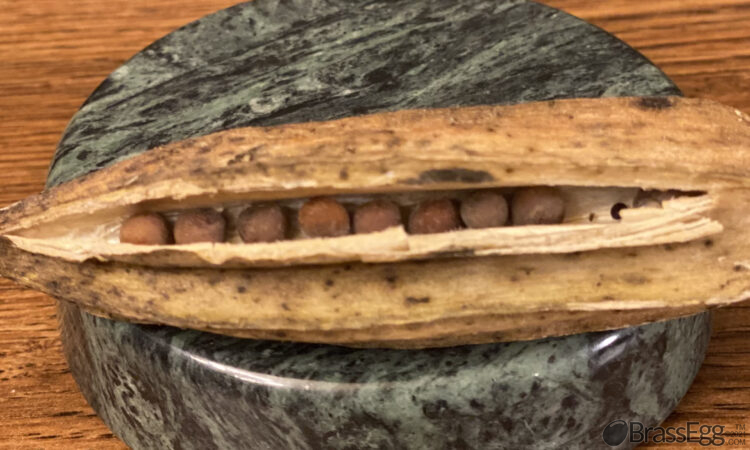
One month later in early November it had dried out and all the leaves had fallen off. Perhaps I should have let this seed pod remain on the plant for a few more weeks to allow it begin to crack open on it’s own. The plant was in the area I was planning to move the coop too though, so I had to pick it. 44 seeds came out of this one pod. Only 1 was clearly not viable, you can tell from the shriveled shape of the small seed on the closest edge of the paperweight. The rest appear to be fine until….

Opening the original seed packet reveals that the commercial seeds all have a dark slate coloring. In comparison my 2020 Zone 5 Okra seeds look brown and immature. This could be a cosmetic preference of the seed seller, a slight variation my plant created to survive the cooler weather, or maybe they are not fully mature. I won’t know until next year when they start coming up out of the ground. Can’t wait to compare my 2020 Zone 5 to the original South Texas Heirloom!

Okra is a Southern Side dish I don’t see often now that I’ve moved North. If you get a helping of it up here, it was likely raised in India and shipped over. If you want to do a deep dive on the subject, there is an entire book on Okra! There are lots of reasons to grow it as a new gardener, the biggest being that deer and other wildlife won’t mess with it. The stalks and leaves are so prickly that my mom would wear long sleeves and gloves….but she was harvesting a full row at a time. For the absolute best taste, harvest only the best immature okra to make up for supper that night. If you see mature seed pods let them go and harvest them for seed later. The flavor goes downhill rapidly after the first day they’ve been picked, so only harvest a bunch at one time if you plan to cook or prep and freeze them by bedtime.

A second good reason to start out with Okra is because it doesn’t require irrigation and likes well-drained soil. I like it as a “border crop” to create an unpleasant barrier for foraging animals. You can also use it to expand your garden planting area by using a part of the garden that the sprinkler won’t reach or in an area that you are just beginning to improve the soil.

Brass Egg™ participates in affiliate marketing programs. As An Amazon Associate I Earn From Qualifying Purchases At No Extra Cost To You Learn more. Brass Egg™ of Russell Holdings Group, LLC 2021. All content ©2021 Russell Illinois Holdings, LLC. All Rights Reserved.