
The Amazing Amaranth: Chicken Feed, Vegetable, Cereal, and Cut Flower

File this under: “Stupid Stuff I Do So You Don’t Have To.” Growing Amaranth isn’t stupid. It’s a fantastic plant that can be eaten as a micro-green, spinach replacement, cereal grain, chicken feed, landscaping annual and cut flower. If you want to learn more about it’s ancient history, dig in here. However, the 4 ways I went about trying to collect the seeds were all fails! Next year I’ll put entire seed heads into the chicken coop as treats and only harvest 3-4 of the best ones. All the seeds I collect will be put right back into planting next spring….I won’t bother trying to clean and process the seeds for breakfast [but I could].

I didn’t purchase actual Amaranth ‘planting seeds’ for use this summer. We just had some left over organic Amaranth grain cereal which is technically seeds, but could have been completely infertile. You cook it up like Cream of Wheat, but we loved the taste of it even more and it had the same or better high energy morning benefits for us. The fact we liked eating it made me interested in growing it. There was just a little left in the bag, not enough to actually make another pot, so we experimented.

My kids got handfuls of outdated seeds when they wanted to plant around the barn construction site. The builders weren’t done and might trample any new plants, but I wanted the kids to have fun. I wasn’t watching where the kids were tossing the seeds, but a few plants actually sprung up through the clay and heavy foot traffic. The Amaranth grain was organic, so it wouldn’t have been offspring of GMO but I can’t insure that it’s not hybrid.

A few seeds washed down the path and sprouted at the edge of the chicken coop where the curious hens couldn’t reach the sprouting leaves. The big root system of the Amaranth made full use of the chicken coop’s nutrient’s and dripping chicken waterer. By summer’s end it was over 3’ tall which is pretty good for growing out of solid clay so late in the summer.

More and more seeds began to fall out of the maturing seed heads and the hens enjoyed the flavor so much they began to dig a hole at that corner of the coop trying to get every little one.
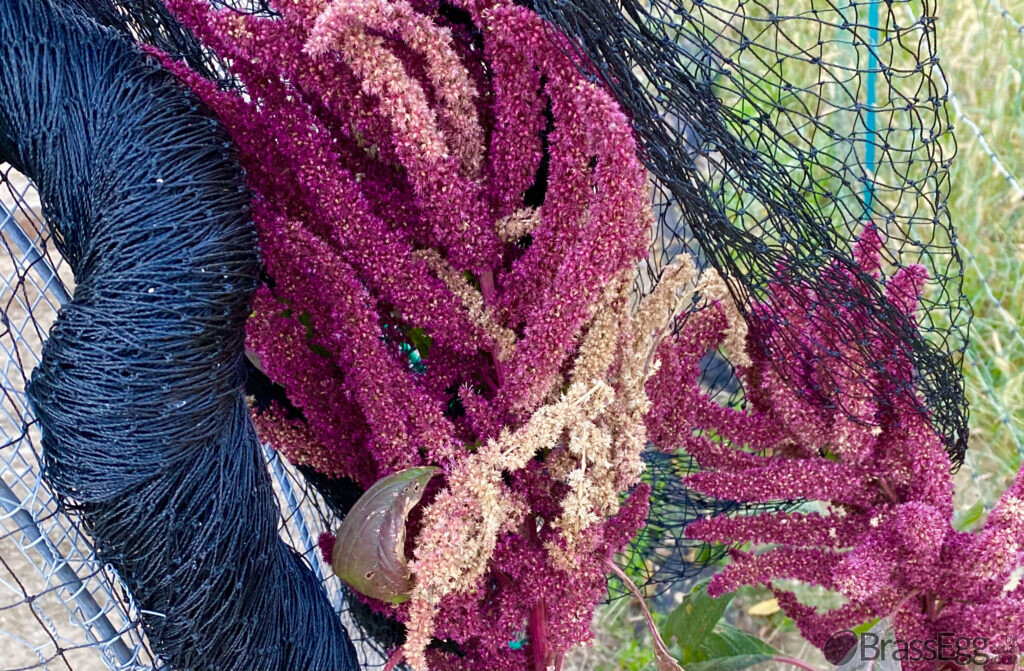
When the beautiful scarlet started to fade to brown it seemed likely they were as mature as they were going to get. I cut off the ‘flowers’ and put them in paper bags and sat the bags in the green house to dry out. We were sure to leave the bag tops wide open.

This is where collecting the seeds gets interesting. My plan had been to just strip each flower/head between my finger and thumb. It was easy to do out in the field. I don’t know if the process of the flower drying out is what made the stickers become an issue, but I wish I had done it out in the field. The first reason is because Amaranth is an excellent self-seeder and harvesting the seeds in the same area that you intend to plant next year can really give you a head start. The second reason I wish I had collected seeds outside is because Amaranth pop out of the seed heads at random angles with springy velocity. I have seeds shoved down in the cracks of my dining room ‘office’ floor now that will nether become chicken food nor grow into a giant Amaranth. The third reason to do this outside is the dust that now coats everything in my office. I probably need to replace my furnace filter now.

Method #1 Fail. When I went to remove the seeds later using my finger and thumb I discovered little tiny ‘stickers’ in my fingers. So small I couldn’t see them without my camera zoom, but I got them out with careful rubbing. The stickers felt like fiberglass and I couldn’t take it after a while. I don’t find any mention on-line of Amaranth seed pods having stickers, so perhaps growing one from a seed catalog would do away with this problem.

Method #2 Fail. Next I tried using a larger dinner fork and running that down the stem. This simply knocked off large flower plumes and shot tiny seeds all over the dining room ‘office’. The dog loved it though!

Method #3 Fail. Crushing the flower heads in the paper bags I had stored them in seemed to help reduce their volume and I could hear seeds falling to the bottom of the bag. However, the stems poked random holes in the paper letting more seeds spill on the floor. Puffs of dust came out of the top of the bag because some of the seed heads had toppled the plants over into muddy puddles during the heavy fall rains. When I peek inside the bag some of the flowers look like they haven’t been touched.

Method #4 Fail. Pouring the contents of this torn paper bag over a screen of hardware cloth releases more dust into my dining room ‘office’. The dog has seeds and flower stickers on his muzzle now. Everything just sits on top of the screen. Rubbing my hand across the pile doesn’t expose the back of my hand so I get much less of that fiberglass effect. The seed pods do get broken up, but leaves, stems, flower petals and a whole foxtail make it through. The 19 ounce end result is unacceptable if sold on the open market, but should serve my purposes just fine this coming spring as I try to convert the solid clay construction site into a decent garden.

What I should have done was follow the advice on the Internet and used an old pillow case. Fill the pillow case up, beat it against our concrete retaining wall and throw the stems into the coop so the hens could get the last clinging seeds. Below freezing today and flurries…so my dining room ‘office’ seemed a better spot. It wasn’t. It made a mess that created dust throughout the house.

Like I mentioned earlier, my first priority next year will be to cut off an entire seed head and hang it in the coop. The chickens adore the flavor of the high protein seeds and the velocity that the seeds pop out creates entertainment for family and fowl. Planting several on the edge of the coop and chicken yard lets the birds make use of the shade and periodic falling seeds. The Amaranth will again get the extra nutrients and moisture the chickens provide.

This haphazard experiment went so well I intend to plant the entire 19 ounces of seed/stems/petals into the red clay ‘garden’, chicken run and in among the erosion control area grasses. Maybe we can create some summer shade for the greenhouse and barn. Next year I may purchase these Amaranth seeds for comparison, although I’m also excited to see how my saved seeds will fair next year with earlier planting and slightly improved soil.

Brass Egg™ participates in affiliate marketing programs, and may receive compensation when you click and purchase from links to retailers. Brass Egg™ of Russell Holdings Group, LLC 2021. All content ©2021 Russell Illinois Holdings, LLC. All Rights Reserved.

Coton De Tulear: Quarantine Puppy was the Highlight of 2020

We are so thankful this year for something we never thought we would have; a dog! We live in a ‘Lockdown State’ and after months of the kids not having school, sports or extended family I was becoming concerned. The kids created a PowerPoint presentation full of promises about how they would take care of the dog, and the benefits of dog ownership. I knew few of those promises would be kept, so I was shocked when my allergy-suffering husband said he would consider getting a dog. The kids began researching all different kinds of ‘hypo-allergenic’ dogs and then narrowed it down to smaller sized dogs that aren’t as prone to barking and that can love a whole family, not just one person.

There really weren’t many dogs that fit those criteria. The kids each presented 3 dog ideas and the Coton was on two lists. It also looks very similar to the West Highland Terrier that I had coveted in college. Marrying my dear husband meant giving up my plan to have a little Westie.

Picking the breed was time-consuming and when we finally settled on one we thought we were done. Apparently the rest of the nation wanted a Quarantine Puppy because dog kennels everywhere were sold out and taking deposits for puppies that hadn’t been conceived yet. Coton De Tulears are rather rare anyway, so when I contacted 39 kennels in 16 different states, a few of the owners were kind enough to not outright laugh at me. I finally located a kennel with only a phone number that had a mention in an out of date directory. It was a 12-hour round trip drive, which was much better than kennels I would have had to fly to (and still had no puppies and only a waiting list). The kennel owner said her last puppy was spoken for by one of her past clients, but the family hadn’t contacted her in a month. I said I would drive up that night with cash. She called me back the next morning and said her client wanted to wait for the next litter so they could go on vacation (lucky ducks). We named him King Louie.

Why do I tell you all this? So you will be prepared if you decide to buy this breed. Kennel owners are in love with their dogs. One kennel owner had a 15-page application to adopt a puppy. One owner required a phone call to be comfortable enough to sell me a dog. Almost all owners required some sort of written statement that I would care for the dog his entire natural life or return him to the selling kennel. My family raised and trained German Shepherds for Sheriffs, Police forces and personal protection my entire childhood, but we never had restrictions like this. I was willing to jump through any hoop, because this seemed to be the only breed that met all our needs.

All my experience with German Shepherds and a random Afghan Hound did not prepare me for a Coton though. All dogs are wonderful (juries out on the Afghan Hound, but all other dogs) and they can all help smooth the rough patches in childhood, I knew that first hand. A Coton is classified as a ‘companion’ dog though. A classification that doesn’t exist on the AKC registry. After several months I understood why there was a 15-page application and why one seller called herself a ‘full-time stay at home dog mom’!

Again, all dogs are wonderful, but this breed loves everybody! I’ve caught Mr. Allergy putting his face right into Louie’s baby soft fur right after his bath (as Mr. Allergy is on his way to his own shower). Louie doesn’t resort to barking to get his way, though he does chime in when we are singing “Happy Birthday”. And he uses the dog door knob bell to tell us when he wants to go out. When I hear his little nails tap the window I know he’s ready to come back in.

This breed is well-known for the ability to walk on their hind legs. It’s the one trick we try to improve on. Any dog can be trained to do tricks, so I’m not telling you this to toot our own horn about what a great job we’ve done training Louie. We haven’t. We’ve done a terrible job training Louie. There are five of us, no consistency in hand commands, no consistency in house rules, and no consistency in daily schedules. He will mess with anything left on the ground, so I had to get him these non-tipping food and water bowls.

I had to get a Kong version of this kennel mat because he dug holes into his first two then ate the stuffing. Louie doesn’t come when you call. With the weather turning cold he doesn’t like to walk into wet grass and has had a few accidents in the house even though we thought he was potty trained. Plus he drags you all over the road when you go for a walk! Louie’s good attributes are all natural tendencies ….. I’ve used none of my dog-training experience with him. We are just reaping the benefits of his good personality.

Some of these good attributes could be a problem if a Coton doesn’t fit your lifestyle. First off, that hair! Summer time means Louie comes straight inside and sits on the air conditioner vent. A Coton grows long hair, not fur. That is a major reason he creates less allergy issues. However, you have to decide if you are going to brush him EVERY SINGLE DAY or if you are going to pay in the neighborhood of $40 every few months to get it all trimmed down into a Puppy cut. We opt for the Puppy cut, but we weren’t paying attention and he had to have his ears shaved because of matting (which hubby said looked like a slice of baloney on his head). Better to keep even the ears trimmed down if you aren’t going to spend that time every day.

The second issue is that even a really good dog is still a dog. He will scratch things, he will destroy the occasional rug, he will need walks, and he will pee on your son’s bed if his whining goes ignored. You will still have to pick up his poo on walks and if you don’t pick up your lawn pretty often it will get tracked back into your house. The vet costs a couple hundred every time you go, and you will go there more often than you would think.

The third issue is that this little 14-17 pound ball of fluff isn’t going to go mountain climbing with you. This is good if you wanted a dog who could stand being inside all day and would just want one walk a day. He might enjoy a camping trip, but he really isn’t built for long hikes. If you really, really want to take him with you, you better get something like this because you will be carrying him at some point. All little dogs are this way, but his bursts of speed might deceive you about his abilities. Yes, he can easily out run you that last block on the way home, but he will also stop on a dime and collapse down into the grass if he suddenly smells something interesting. Depending on how young and agile you are that might send you for a tumble yourself.

The fourth issue is very much a Coton issue. This goes back to his ‘companion’ designation. The Coton loves everybody, but particularly he loves his people , he wants to be with his people all the time . Most dogs are like this in a way, but the Coton takes it to a co-dependent level. The reason the breeders were so picky about who they sell to is because this dog wants his people more than anything. Louie has not touched his food all day because he didn’t want to be away from his people . I have to remind him and sometimes call him in to his food while I do laundry so he won’t be alone while he eats. When he was a puppy my daughter would sit and wait with him so he would eat. Yes we’ve totally spoiled him because we had lost hope of ever having a dog, but he is also a total delight. For us, Louie is the family’s ‘Emotional Support Animal’. [With all due respect for those who have an officially designated animal.] The Coton has earned the nickname of the clown dog for many years. It recently was also dubbed the anti-depressant dog.

In my mind, having a dog is very much part of an abundant lifestyle. The concept of homesteading can range far and wide. Depending on your money, job and geographic situation you can range all the way from ‘off the grid water harvesting’ to ‘aquaponics in a high-rise apartment’. My particular flavor is to plan for my family’s future despite what the cost is today. So yes, my hen coop and fence costs more than I would spend on organic eggs for the next five years. Yes, my greenhouse costs more than I will ever spend on tomatoes and peppers. Yes, our forest land costs more than we have ever spent on vacations. And yes, Louie costs more than we spend on toys for the kids. However, a distraught child just scooped up Louie on the way to their room. That is the value of a dog to me. Tears are expensive, and by that count Louie is a bargain.

Brass Egg™ participates in affiliate marketing programs, and may receive compensation when you click and purchase from links to retailers. Brass Egg™ of Russell Holdings Group, LLC 2021. All content ©2021 Russell Illinois Holdings, LLC. All Rights Reserved.

Make a Suet Cake for Your Chickens Using Food Waste

We are used to seeing suet cakes in the winter advertised to help the birds in cold weather. Cold and wet weather means that non-migrating birds need more calories in their diets. The fat in a suet cake fills that need perfectly well. Although I love to see a red cardinal in the winter, my favorite non-migrating birds are my lovely hens scratching around in the yard.

Even if you give your hens the most beautiful and elaborate shelter, they will choose to get out in all sorts of weather. Chickens are incredibly cold hardy despite their small size and will commonly walk out into the snow to satisfy their curiosity and love of the fresh air. As long as their shelter is available to them as a free choice they will decide when they need to warm up and when they want to play in the yard.

There are lots of cute ideas on the web about how to make Suet Cakes that use bird seed, raisins, nuts and such, but I get really excited about ways to feed my chickens using kitchen scraps. [Yes, I know I need help.] For me, a Suet Cake for my chickens takes it up a notch because I am able to use the extra cooking grease that is so hard to dispose of anyway.

My husband covets bacon grease (I’m not really a fan), but beef and chicken drippings are really just a hazard to dispose of. Anyone teaching a kid to cook has probably had the fun of trying to calmly explain to the child why you told them 30 minutes ago not to pour cooking fat down the drain as you try desperately to heat up the sink and pipes before the fat creates an impenetrable clog.

Making your own Suet Cake is not only a win for your sink, a win for making use of kitchen waste, and a win for your hen’s winter diet: but I also found a grain and seed substitute that makes use of that ‘dust’ that your hens won’t eat in the feeder…quadruple win!

If your hens are like mine, they will gobble up the pellets and refuse to eat all the little crumbs in the tray. If you hang your feeder high enough they won’t be able to scratch it out on the ground, but they will still use their beaks to display their disdain for it. I need to find an easier way to do this, but this time I sifted that out and collected it. I just keep a jar under the sink with this ‘pellet dust’ and I can mix up a ton of suet cakes at once when their are left-over drippings. I’m guessing it is full of minerals the girls should be eating anyway.

Keep adding dust past the ‘brownie mix’ stage and go all the way to ‘wet sand’ stage. Press it down into your container, put the lid on and pop it into your fridge or freezer. It will harden up fairly quickly. Make them into whatever shape you can easily pop out. They don’t make my little round Ziplock containers anymore, but these Glad rectangular ones are also 8oz just like the containers I use for the whole process.

I bought this large suet cake holder that I not only use for winter snacks, but also for holding produce up off the ground to entertain the hens. It’s my favorite way to get rid of a zucchini I forgot about in the fridge. As I have been making these, I try to make them bigger and bigger because it’s a more efficient use of my time and space….and at some point I may buy a flock block if I find I fall behind in having enough snacks.

Here you can see the chickens pulling out cucumbers and then carrying them off to their own corners. They love things like cucumbers and squash! There are lots of great suet cake holders out there, but the one I have here is heavy-duty. If you want one like mine, look for an easy to fill one because the hens act like little toddlers waiting for candy. I’ve had a hen more than once jump up waist high and try to nab a treat. It’s all one compartment so you can pop really big things in. We’ve put about 10 corncobs in there after supper and watched the chickens for an hour. It’s just nicer to have it up off the ground so it doesn’t become an eyesore. They also aren’t eating dirt and other ‘stuff’ accidentally. (I’m sure they eat enough of that on purpose!) Because it swings from a chain all over the place it seems to entertain them more too, and that’s even more fun to watch.

Brass Egg™ participates in affiliate marketing programs, and may receive compensation when you click and purchase from links to retailers. Brass Egg™ of Russell Holdings Group, LLC 2021. All content ©2021 Russell Illinois Holdings, LLC. All Rights Reserved.